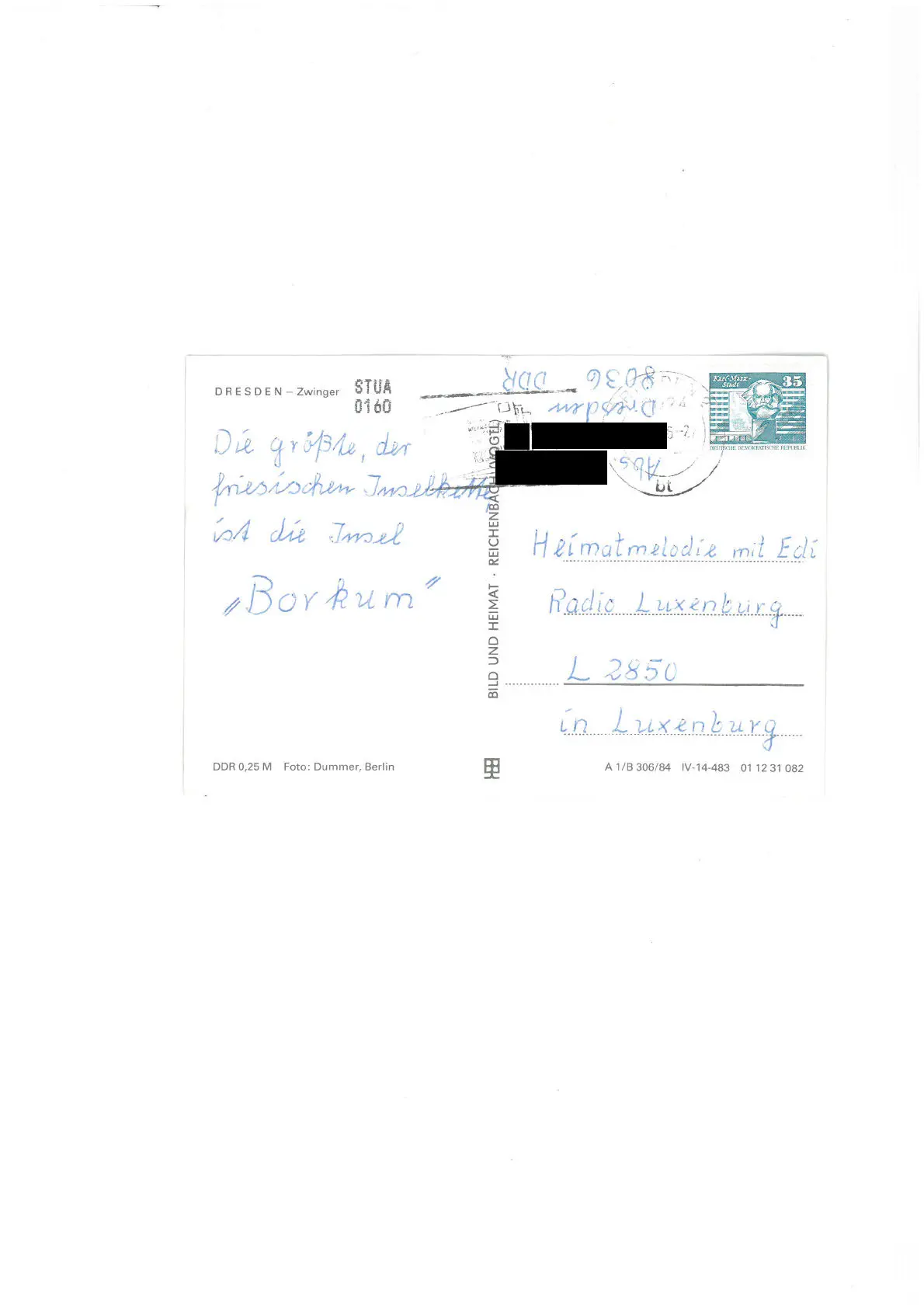
Letters to a radio station that, for many people in communist East Germany, meant a small piece of freedom - intercepted by the secret police, forgotten for decades in the archives, rediscovered by a man who once secretly tuned in to Radio Luxembourg himself. Curator, contemporary witness and former political prisoner Michael Teupel on a find that made headlines across Europe, on the fates hidden behind unremarkable envelopes - and on a publicly funded remembrance agency that waves him away.
Some background for international readers: the German Democratic Republic (GDR) was the Soviet-aligned East German state that existed from 1949 to 1990, sealed off from the West by the Berlin Wall and watched over by the Ministry for State Security - the Stasi - one of the most pervasive surveillance apparatuses in history. Radio Luxembourg, broadcasting from the small Grand Duchy between Germany, France and Belgium, is remembered by British listeners of a certain age as the station that brought rock’n’roll to airwaves the BBC still dominated; its German-language service played much the same role for young people on both sides of the German-German border. In the GDR, quietly listening to Western stations was one thing. Writing to one was quite another.
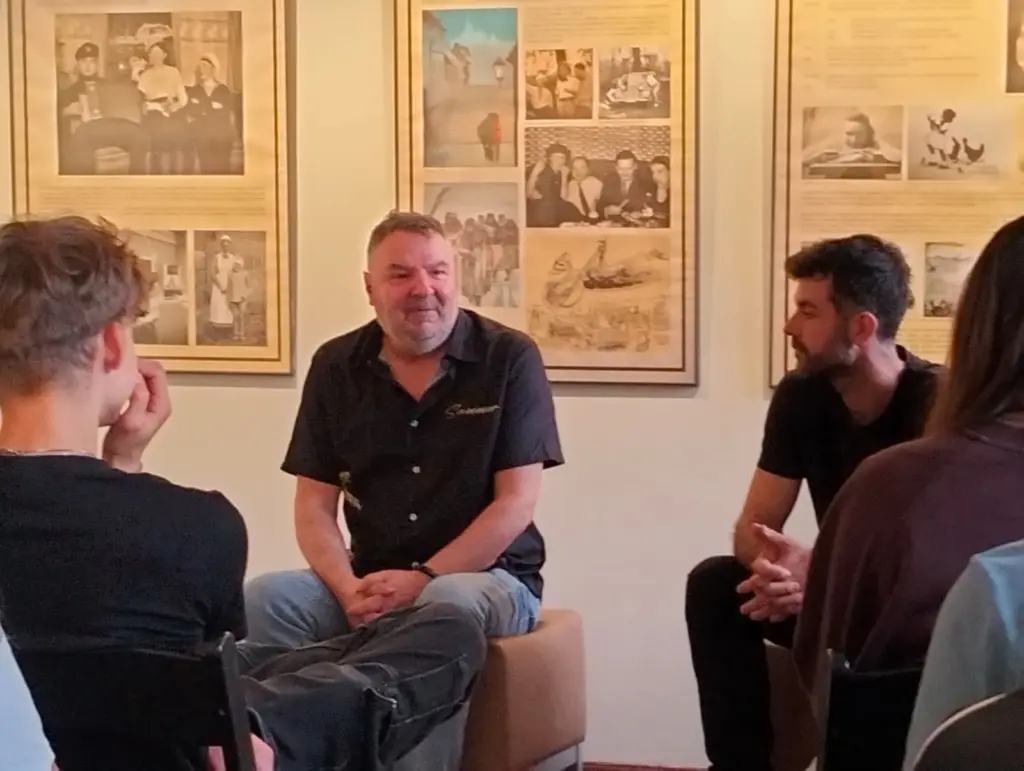
Hergisdorf/Halle (Saale). It begins with a small gesture. Michael Teupel, an independent curator and contemporary witness from the eastern German state of Saxony-Anhalt, is looking for a gift for his hosts. He has been invited to the Grand Duchy of Luxembourg through the Austrian-born television and radio legend Frank Elstner - a longtime Radio Luxembourg voice whom German audiences know above all as the creator and original host of “Wetten, dass..?”, for decades the biggest Saturday-night entertainment show on European television. Teupel is to speak there about a chapter he knows from personal experience: as a teenager in the GDR he listened to Radio Luxembourg - the station that, for young people behind the Iron Curtain, meant freedom, hope and a connection to the Western world.
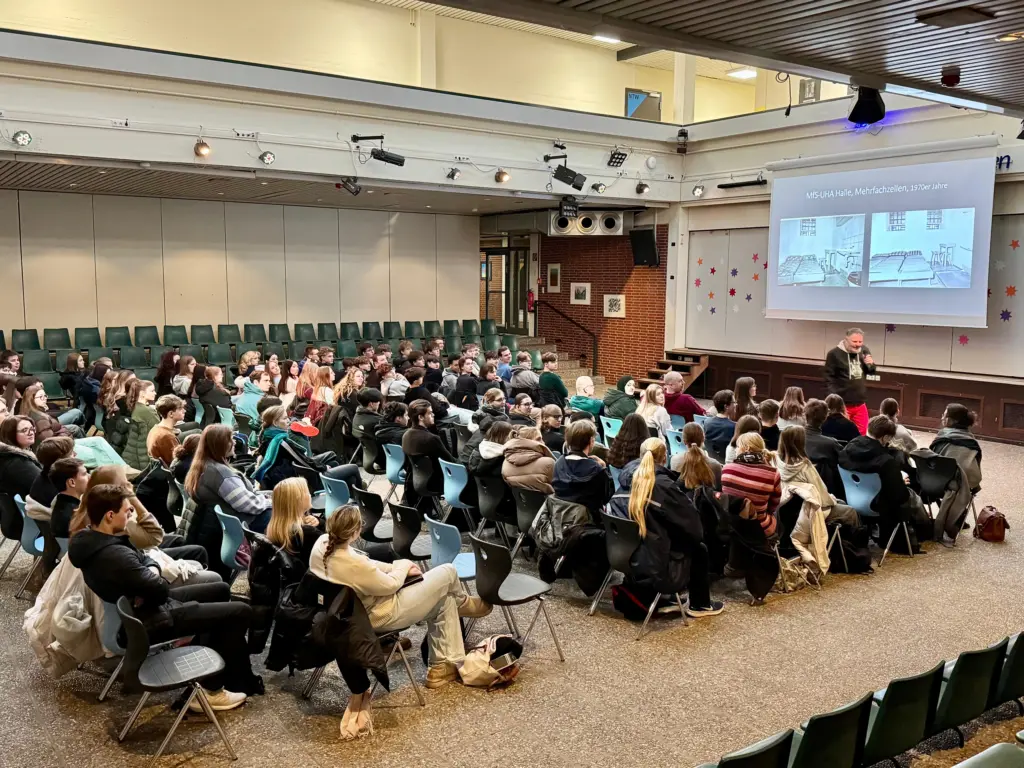
It is an invitation that fits his life’s work: for years, Teupel has travelled across Germany giving talks to school students about the SED dictatorship - the rule of East Germany’s communist party - and about strengthening democracy. While searching for a suitable gift, he remembers a display case in what was then the Stasi Records Archive in Halle, where the files of the East German secret police are kept and, since reunification, opened to the public. On an earlier visit he had spotted an envelope there, addressed to Radio Luxembourg. An unremarkable piece of paper - and, as it would turn out, the beginning of an extraordinary discovery.
A broken printer, two hours on the phone - then the archive opens up
Contact with the head of the Halle archive, Marit Krätzer, is quickly made - they know each other from remembrance projects Teupel himself initiated in Halle. His request is modest: drop by, photograph the envelope, show the document at his talk in Luxembourg. No problem in principle, he is told - but it requires a formal research application.
What follows is German archival reality in all its stubbornness: the form arrives by email, but Teupel’s printer gives up, so the application travels back and forth by post. At times he wonders whether the cost and effort are worth it at all. He sends the application anyway. Weeks of waiting, then the Federal Archives in Berlin - the Bundesarchiv, which took over the Stasi files in 2021 - calls. The young voice on the other end strikes Teupel as trustworthy; they will be in touch soon. A little later, two emails arrive from Berlin - and once again it takes around two hours and several phone calls before Teupel can actually start working through the first digitised documents.
Then begins a discovery that will not let go of him.
Letters that never reached their recipients
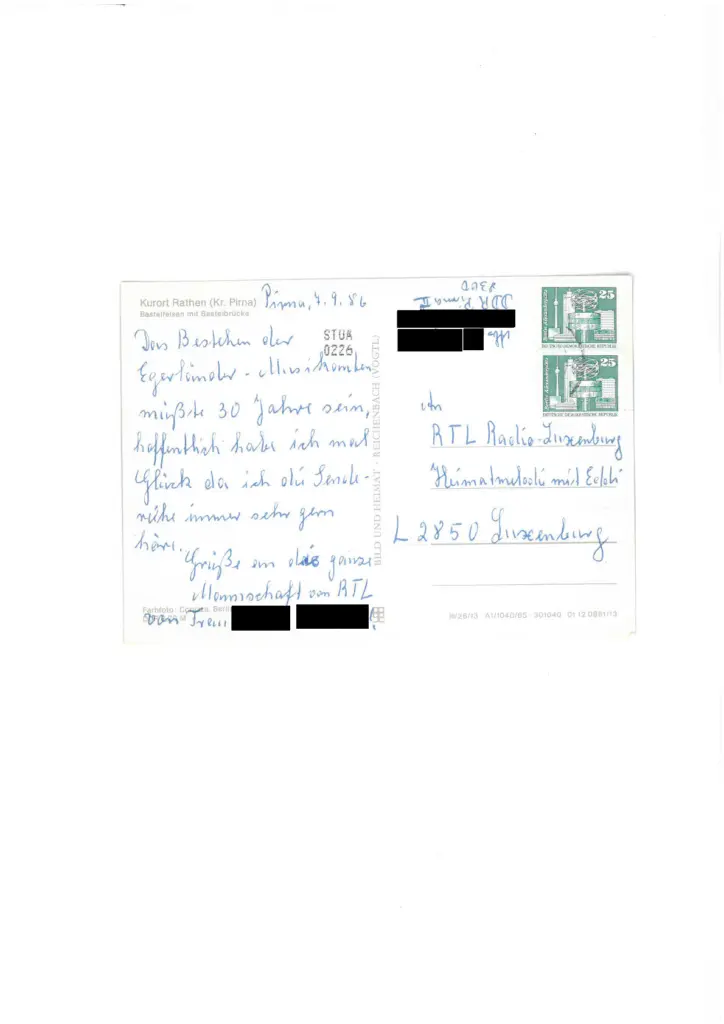
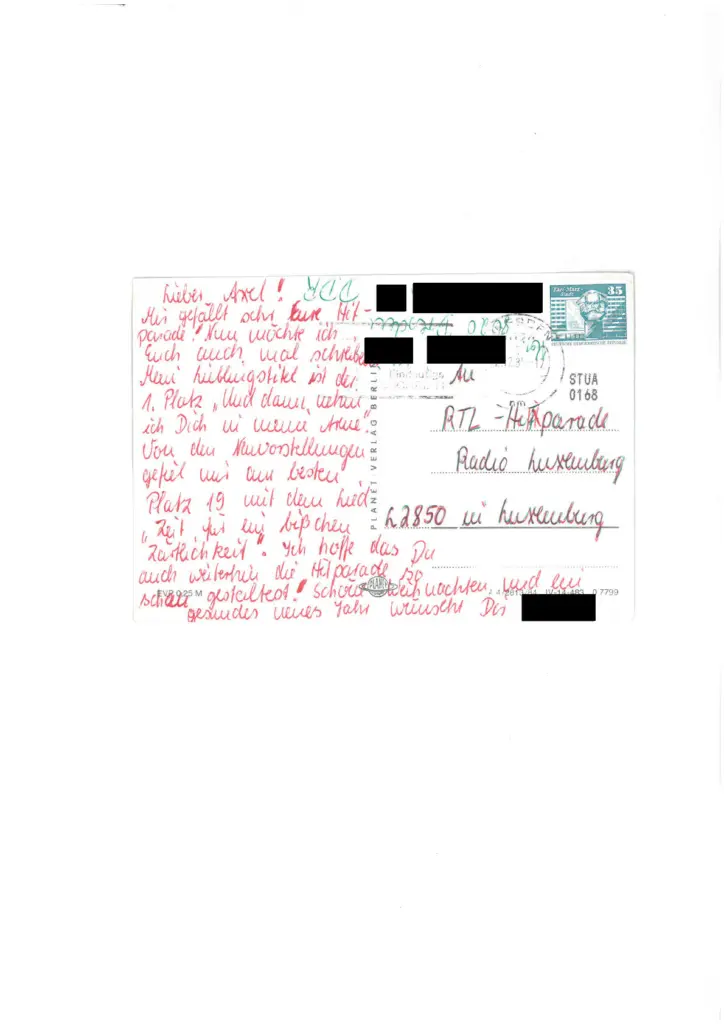
Personal letters and postcards from the GDR appear on his screen. People had written them because they were seeking contact with the Western world, wanted to reach their favourite presenters, or simply to express their enthusiasm for Radio Luxembourg. None of it ever arrived. The mail was intercepted and registered by the Stasi, which ran an entire department devoted to secretly opening, reading and confiscating private post.
The lines, many of them from the 1980s, move Teupel deeply; reading them, he is repeatedly brought to tears. Behind every letter stands a human being with hopes, wishes and a story of their own. What was mere surveillance material to the secret police turns out, decades later, to be a unique testimony to everyday life in East Germany.
Teupel starts analysing the material the same day. The find ultimately comprises hundreds of archived records, a strikingly large share of them from the former Dresden district. There is a historical irony in that: the Dresden region was mockingly known in the GDR as the “Valley of the Clueless”, because West German television signals barely reached it - which may be exactly why Western radio mattered so much there. And Teupel does not keep the discovery to himself: that same day he informs Frank Elstner, Radio Luxembourg and the Saxon State Commissioner for coming to terms with the SED dictatorship. These letters, he believes, belong in the public eye.
Twice on the front page
What began as a small piece of research for a talk becomes a media event. Newspapers and broadcasters in several European countries pick up the story, Teupel gives interviews - and his find makes the front page twice, first in WELT and later in the Süddeutsche Zeitung, two of Germany’s leading national dailies.
By now at the latest it is clear: this is not merely an interesting archival find. The documents tell a little-noticed chapter of the history of divided Germany - and show how far the Stasi’s surveillance reached into the most private sphere of all: the letterbox.
An autograph request, a year in prison
Teupel does not stop at the first discovery. While still working through the Dresden documents, he files another research application - and strikes again. This time, letters and postcards surface from Brandenburg as well as from Rostock, Schwerin and other regions of northern East Germany. The number of documents there is smaller, but individual pieces reach back as far as the 1960s.
Particularly moving is the case of an 18-year-old school student from Rostock. He wanted an autograph card from one of Radio Luxembourg’s presenters. The card never reached him - instead, his wish for contact with the Western station drew the attention of the Stasi. For what was classed as establishing contact hostile to the state, the young man was sentenced to a year in prison. An autograph request treated as a case for political persecution: such fates make clear that this is about far more than old letters. It is about people whose lives a dictatorship monitored and, in some cases, destroyed.
An exhibition takes shape
After the first reports appear, Biggi Lechtermann - a radio and television presenter well known to German audiences, whose own career began at Radio Luxembourg - also gets in touch with Teupel. Both know what the station meant to generations of listeners. In a phone conversation lasting more than an hour, a shared idea emerges: an independent exhibition that tells not only the story of the station, but above all makes visible the fates of the people who, despite every prohibition, sought contact with the Western world from inside the GDR.
Frank Elstner, too, is delighted by the discovery. In April 2027 he is expected as a guest at Teupel’s talk in the Grand Duchy on the forbidden and surveilled communication between East German citizens and Radio Luxembourg. For Teupel, a circle closes: a former listener who once secretly switched on the station brings the stories of those people back to Luxembourg decades later - the people whose letters never arrived there.
Why Dresden is missing an opportunity
Less encouraging, so far, is the contact with the Saxon State Commissioner for coming to terms with the SED dictatorship - a publicly funded office created precisely to support this kind of remembrance work, and of all places in the region where most of the finds originate. Although Teupel informed the office early on, and the first media reports had already appeared, no substantive response came at first. A staff member, he says, told him in essence that the topic evidently was not of interest to the office as long as its director did not take it up. A further attempt, according to Teupel, also failed to lead to any cooperation.
Yet Saxony would be the obvious place for the exhibition: a large share of the documents comes from the Dresden region and records people who, despite state repression, kept up their interest in the Western world. A look at Saxony’s 2025 budget shows that total expenditure of 713,900 euros was earmarked for the State Commissioner’s office, 525,800 euros of it for staff. Teupel therefore poses a fundamental question: What role does active support for independent remembrance work play when a curator approaches a public agency with an internationally noted find?
Personal recognition or money is not what drives him - he deliberately works independently and finances many of his remembrance projects himself. What he would have wished for was a professional exchange and a willingness to think together about the historical significance of the documents. For now, he has shelved the plan to show the exhibition in Dresden; without a reliable partner, the financial and organisational risk is too great. He is disappointed, certainly - but it is precisely the people of Saxony, he says, who have a special claim to getting to know this history.
Giving up, however, is not on the curator’s mind. Other cities and institutions will be found, he is convinced. The documents are to come out of the archives and back into public awareness. Because these letters have a story to tell: of curiosity, longing, courage and state surveillance - and of people whose voices the Stasi wanted to silence, but who are being heard after all, decades later.
Michael Teupel spoke exclusively to the Pester Lloyd. His own story, incidentally, begins in Hungary: in 1980 his attempt to flee the GDR via Hungary to Yugoslavia failed - a route many East Germans tried, since Hungary’s border with non-aligned Yugoslavia seemed to offer a way out of the Eastern Bloc. He was arrested and imprisoned as a political prisoner; the escape attempt nearly cost him his life. He is expected to tell that story in the Pester Lloyd in January 2027.
Sources: Michael Teupel in conversation with the Pester Lloyd, material and research documents provided by Michael Teupel
Photos: Michael Teupel’s archive
Unser monatlicher Nachrichtenspiegel: die wichtigsten Meldungen aus Ungarn und Mitteleuropa, einmal im Monat per E-Mail. Kostenlos, kein Spam, jederzeit abbestellbar.
Nachrichtenspiegel kostenlos abonnieren
Neu · Jeden Freitag als PDF
Der Pester Lloyd als Wochenzeitung - wie früher am Kiosk, nur digital
Ausgabe 16.-22. November 2026, 22 Seiten im großen Zeitungsformat. Darin unter anderem:
• Riemann-Vermutung gelöst? Anthropic-Mathematiker meldet KI-Beweis, Experten prüfen weltweit• Magyar stellt Autobahn- und Tabakkonzession infrage - Regierung kündigt Bruch mit langlaufenden Verträgen an
Zeitung ansehen - 2,50 €In eigener Sache - Ihr Kauf unterstützt unabhängigen Journalismus ohne Paywall.