At the 3rd edition of the conservative Budapest Global Dialogue, Orbán casts a grim and ideological ladden picture.
Budapest. At the opening of the Budapest Global Dialogue 2026, Balázs Orbán, political director to Prime Minister Viktor Orbán, sketched a stark diagnosis of European politics: a widening divide between political elites and ordinary citizens. Speaking at the panel “Restoring Civilisational Self Confidence: Which Values Secure Our Future?”, Orbán argued that the foundations of democratic decision making in Europe were being reshaped not only by institutions, but by algorithms.
According to Orbán, global technology platforms now exert decisive influence over the political information citizens encounter. Social media algorithms, he said, no longer merely distribute content but actively shape political reality. If these systems are not neutral, they can reconfigure an entire country’s political environment. In that sense, the issue transcends free speech and becomes one of democratic integrity and national sovereignty.
The conference, held in Budapest and co-organised by the Hungarian Institute of International Affairs and India’s Observer Research Foundation, provided a familiar but sharpened stage for this argument. Orbán acknowledged that Hungary, due to its size and the limited global reach of the Hungarian language, could not realistically build its own social media ecosystem. The task, he argued, was therefore to enforce fair and neutral operating conditions on international platforms. Ensuring such conditions, he said, was essential if democratic choices were to remain genuinely free. This, in his words, was a challenge Europe and its member states would have to confront within the next decade.
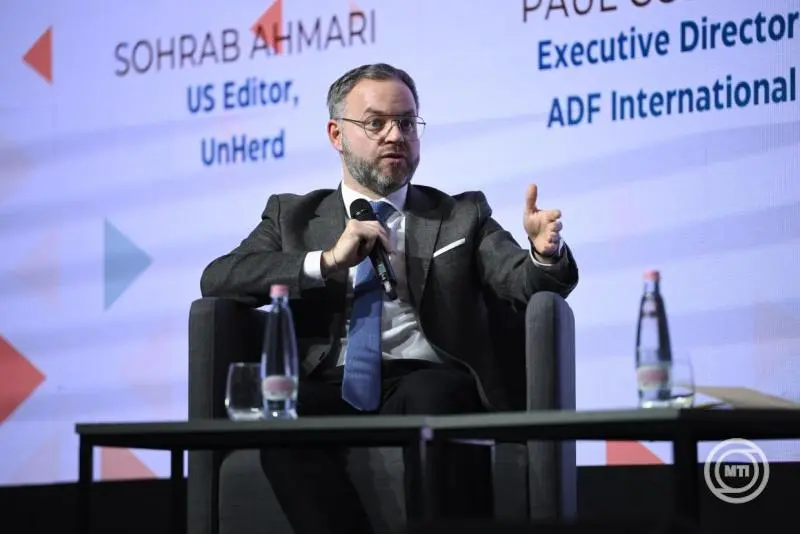
Photo: MTI/Boglárka Bodnár
From digital power, Orbán moved to electoral politics. Elections, he insisted, remained the decisive corrective mechanism, and Europe needed political change. The current liberal leadership, he argued, should be replaced by 2029. Without such a shift, Europe risked being drawn into a full scale war. The warning was deliberately blunt and consistent with Budapest’s long standing narrative positioning itself as a reluctant dissenter within the European mainstream.
On the war in Ukraine, Orbán contrasted what he described as a pro peace approach in Washington with what he portrayed as Brussels’ interest in prolonging the conflict. “Peace is Europe’s fundamental interest,” he said, framing the continuation of the war not as a moral imperative but as a strategic failure that increasingly runs against the continent’s own security and economic stability.
Orbán placed these arguments in a broader ideological context. The era of neoliberal globalism, he declared, was over; what followed was “the age of nations”. States that wished to remain successful would prioritize sovereignty, security and energy independence. The formulation echoed a core tenet of the Hungarian government’s worldview, in which globalisation is treated less as an economic process than as a political constraint imposed from outside.
The panel reflected this transatlantic and ideological mix. Alongside Orbán sat Sohrab Ahmari, US editor of UnHerd, Paul Coleman, executive director of ADF International, and Sarah B. Rogers, US Under Secretary of State for Public Diplomacy and Public Affairs. Their presence underscored the conference’s ambition to frame cultural, political and geopolitical questions as elements of a single civilisational debate.
What emerged in Budapest was not a new position, but a more concentrated version of Hungary’s critique of the European status quo. Digital platforms were cast as quasi sovereign actors, Brussels as strategically misguided, and elections as the remaining lever for systemic change. Whether this narrative convinces beyond Hungary’s political allies remains open. What is clear is that Budapest continues to present itself as a diagnostic voice in Europe’s internal crisis and as an advocate of a future defined less by integration than by national self assertion.
Sources: MTI, Wikipedia, Hungarian Institute of International Affairs, Observer Research Foundation
Photo: MTI/Boglárka Bodnár
Unser monatlicher Nachrichtenspiegel: die wichtigsten Meldungen aus Ungarn und Mitteleuropa, einmal im Monat per E-Mail. Kostenlos, kein Spam, jederzeit abbestellbar.
Nachrichtenspiegel kostenlos abonnieren
Neu · Jeden Freitag als PDF
Der Pester Lloyd als Wochenzeitung – wie früher am Kiosk, nur digital
Ausgabe 12.–18. Oktober 2026, 17 Seiten im großen Zeitungsformat. Darin unter anderem:
• Schachecke: Evergreen, Joghurt, Zeitnot: Gewinnzüge im Detail• Polyák an der Schaltstelle – Was sich in Ungarns Medienaufsicht ändert
Zeitung ansehen – 2,50 €In eigener Sache – Ihr Kauf unterstützt unabhängigen Journalismus ohne Paywall.