
Who Controls the Stage? The Situation of Hungarian Theatre in Analysis and an Interview with Theater Historian Zoltán Imre
Budapest. Both, the Hungarian Újszínház (New Theatre) and the Nemzeti Színház (National Theatre) are led by two right wing and, in case of Attila Vidnyánszky, highly influantial figures: “Far-right extremist Dörner remains director of the Budapest New Theatre,” says the translated title of an article of the Neue Musikzeitung, reported in 2016 on the occasion of György Dörner’s reappointment by the Budapest city assembly for another five-year term. Dörner had already been appointed director of the Újszínház (New Theatre) in 2011 for the first time. At the time, the decision was widely seen as politically controversial. According to media reports at the time, his appointment was in line with the agenda of then-Prime Minister Viktor Orbán.
In his application, Dörner spoke out against what he described as a “degenerate, pathological liberal hegemony” in the theatre scene.
Despite eleven other applicants, the Fidesz-dominated city council selected him. Observers interpreted the appointment as a cultural policy signal from the government at the time. Dörner’s ideological positioning is also illustrated by his close connection to the now-deceased writer and politician István Csurka, who was repeatedly criticised for antisemitic statements. Dörner is considered a political ally of Csurka and initially planned even to involve him as an artistic advisor after his appointment. He remains at the helm of the New Theatre. In 2022, the Fidesz-affiliated platform DUOL reported the extension of his contract until 2027.
Criticism of cultural policy developments under the Orbán government was also voiced by former National Theatre director Róbert Alföldi. Following the change of government in 2010, he accused his successor Attila Vidnyánszky of using his position to ideologically shape and dominate the theatre sector. Alföldi criticised in particular Vidnyánszky’s extensive powers within the Hungarian cultural landscape. In his view, funding decisions and institutional influence under his leadership reflected a clear political and ideological orientation. He also argued that conservative and partly homophobic positions had become further entrenched in cultural discourse.
Vidnyánszky is also considered controversial due to the number of cultural positions he holds and his role in the restructuring of the University of Theatre and Film Arts in Budapest (SZFE). He is accused of having played a key role in the rightwing political transformation of the historically prestigious institution.
Rethinking the National Theatre
The ideological foundations of the current theatre system are also examined by theatre scholar Noémi Herczog. In her essay Performing illiberalism in Hungary: the ambiguities of an illiberal theatre portrayed by Attila Vidnyánszky’s National Theatre in Budapest on the search for an “illiberal theatre aesthetics,” she analyses Attila Vidnyánszky as one of the most influential figures in Hungarian theatre life. Herczog argues that while Vidnyánszky is closely aligned with Orbán’s political system, his artistic practice reveals internal ideological contradictions. His work combines internationalisation, nationalism, avant-garde elements, and political adaptation.
Among Herczog’s central criticisms are the concentration of cultural power through funding structures and institutional influence in Vidnyánszky’s hands, as well as the privileged position of the National Theatre. It presents itself as a “theatre of the nation,” yet does not represent the diversity of Hungarian theatre culture. Instead, it promotes a conception of theatre that places national identity at its centre while marginalising other perspectives. Herczog ultimately describes the contradictions in Vidnyánszky’s position as a possible key to his success, writing that “gaining international reputation on the one hand, pleasing the pseudo-ideology of illiberal Hungary on the other” works for his reputation.
Zoltán Imres “Re-evaluations of National Theatres in Europe in the 21st Century”
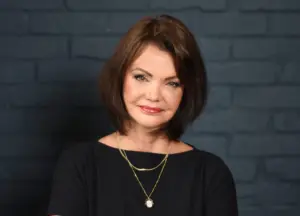
I meet Zoltán Imre in his office at Eötvös Loránd University (ELTE) in Budapest. The theatre historian is an known expert on national theatres and European theatre history. In his essay “Re-evaluations of National Theatres in Europe in the 21st Century,” he examines the redefinition of the national theatre in the 21st century. Imre outlines two central positions: on the one hand, the view that the term “national theatre” has become a largely empty label, as its original function has lost relevance in times of globalisation and European integration. On the other hand, he refers to theatre scholar Janelle Reinelt, who argues that national theatres can still play an important role, provided they are rethought.
In 2007, Imre and theatre director, László Hudi developed the concept “Nemzeti Színház – mindenkinek!” (“National Theatre for Everyone!”). The concept is based on the so called Scottish model as a production company with a pluralistic approach:
“We believed that a national institution should strive to create opportunities for as many activities as possible to take place and reach as many citizens as possible in the capital and the countryside as well. In our National Theatre, we wanted to create a framework that is open to a wide range of artists and audiences on different professional and amateur levels for adults and children alike.”
Instead of a single central institution in Budapest, they propose a mobile network that includes different regions and social groups. The national theatre is thus understood as a space of diversity and exchange.
“We did not intend to create another elite centre in the capital of Hungary. We thought that if there is something that we can call elite, let us not gather it into a single centre, let us not try to tear it out of its natural environment, but let us seek it out and help it to have an effect where it is created and present. We wanted these creators to have opportunities, to have their work supported, to have a focus, but primarily in the places where they are creating.”
For them, a national theatre is only truly “national” when it makes social diversity visible and creates spaces for discussion and participation.
About Funding, Loyalty, and Control in Hungarian Theatre
In the interview, I ask Zoltán Imre about his perception of the current Hungarian theatre landscape, with a particular focus on the independent scene.
Drawing on more than 25 years of experience in the theatre sector, he describes the National Theatre as “seemingly more open, though Vidnyánszky and foreign guest-directors influenced mainly the intuition”, while the New Theatre stages works only by Hungarian authors, including even those containing openly right-wing or antisemitic narratives. The independent scene, by contrast, is structurally disadvantaged and has been chronically underfunded for many years.
Speaking about the Hungarian theatre system, Imre distinguishes between so-called “stone theatres”, meaning state- or municipally or jointly funded repertory theatres with permanent ensembles, and the independent sector, funded basically by the National Cultural Fund (NKA) through yearly application. The National and the New Theatre belong to the “stone theatres”, and despite of their huge economic support, their influence on actual audiences remains limited:
“People simply do not bother to go there. Not even right wings, not even Fidesz-supporters.”
He describes a situation of weak audience engagement in which even subsidised, therefore cheap tickets attract little demand, and sometimes school classes being instructed to attend performances. More central, however, is not the question of audiences but of political control. According to Imre, the allocation of leadership positions was determined most of all by political loyalty in the past 16 year: “the most important thing in the selection was political loyalty.” As a result, especially regional theatres are shaped by politically aligned directors.
At the same time, ideological positioning is not always directly visible in repertoire choices: “you can’t detect directly.” While some productions contain national-conservative or ideologically charged elements, overall repertoires tend to be heterogeneous, including classical works, international, mainly European plays, collaborations, and some contemporary pieces. According to Imre, political orientation is more evident at the level of management than within acting ensembles.
The independent scene, however, is weakened by structural underfunding. This development also has political implications: “the government do not censor them, but silence them by not financing them.” Funding is distributed through the National Cultural Fund (NKA), whose resources for independent companies have significantly decreased in recent years. As a result, many influential independent companies (Krétakör lead by Árpád Schilling, Szputnyik lead by Viktor Bodó, Tünet Együttes lead by Réka Szabó for instance) finished their activities and some of their members and leaders even left Hungary.
Imre also refers to reforms after 2010. A theatre law introduced in 2008 had established six categories and included a binding provision stipulating that at least 10% of state theatre funding should go to the independent sector. After 2010, this system was replaced by a model in which support for the independent sector became discretionary rather than guaranteed.
In retrospect, Imre describes the period before 2010 as a kind of “Golden Age” of the independent scene, despite already existing financial constraints: “from now, that seems as the golden age from the 1990 until 2010.” Regarding the role of the National Theatre, he highlights a major shift under Attila Vidnyánszky. His appointment in 2013 marked a structural break: “first he immediately closed down the repertoire of the previous directorship, and then started to build a sort of right-wing, nationalist repertoire.”
Political tendencies, according to Imre, become visible for instance in the staging of social issues, including discussions around gender issues or the promotion of a conservative family model. Some productions explicitly reflect such narratives, sometimes also through interventions by artistic leadership. At the same time, Imre cautions against generalizing the political stance of theatre personnel. Actors are bound by annual contracts: “if the director doesn’t want to renew your contract, you are jobless.”
When asked about future perspectives, Imre emphasizes the need for the renewal of the cultural dialogue among the different sectors of the theatre world and even for a more urgent need to re-think the entire Hungarian theatre system. After reform debates in the 1990s and early 2000s, a crucial period of systemic discussion was interrupted. Today, he argues, there is again an opportunity to reopen these fundamental questions about the financing and organization of the Hungarian theatres.
Sources: Neue Musikzeitung, hvg.hu, deutschlandfunk.de, Essay: Noémi Herczog’s “Performing illiberalism in Hungary: the ambiguities of an illiberal theatre portrayed by Attila Vidnyánszky’s National Theatre in Budapest”, Essay: Zoltan Imre “Re-evaluations of National Theatres in Europe in the 21st century”
Photo: Zoltán Imre
Unser monatlicher Nachrichtenspiegel: die wichtigsten Meldungen aus Ungarn und Mitteleuropa, einmal im Monat per E-Mail. Kostenlos, kein Spam, jederzeit abbestellbar.
Nachrichtenspiegel kostenlos abonnieren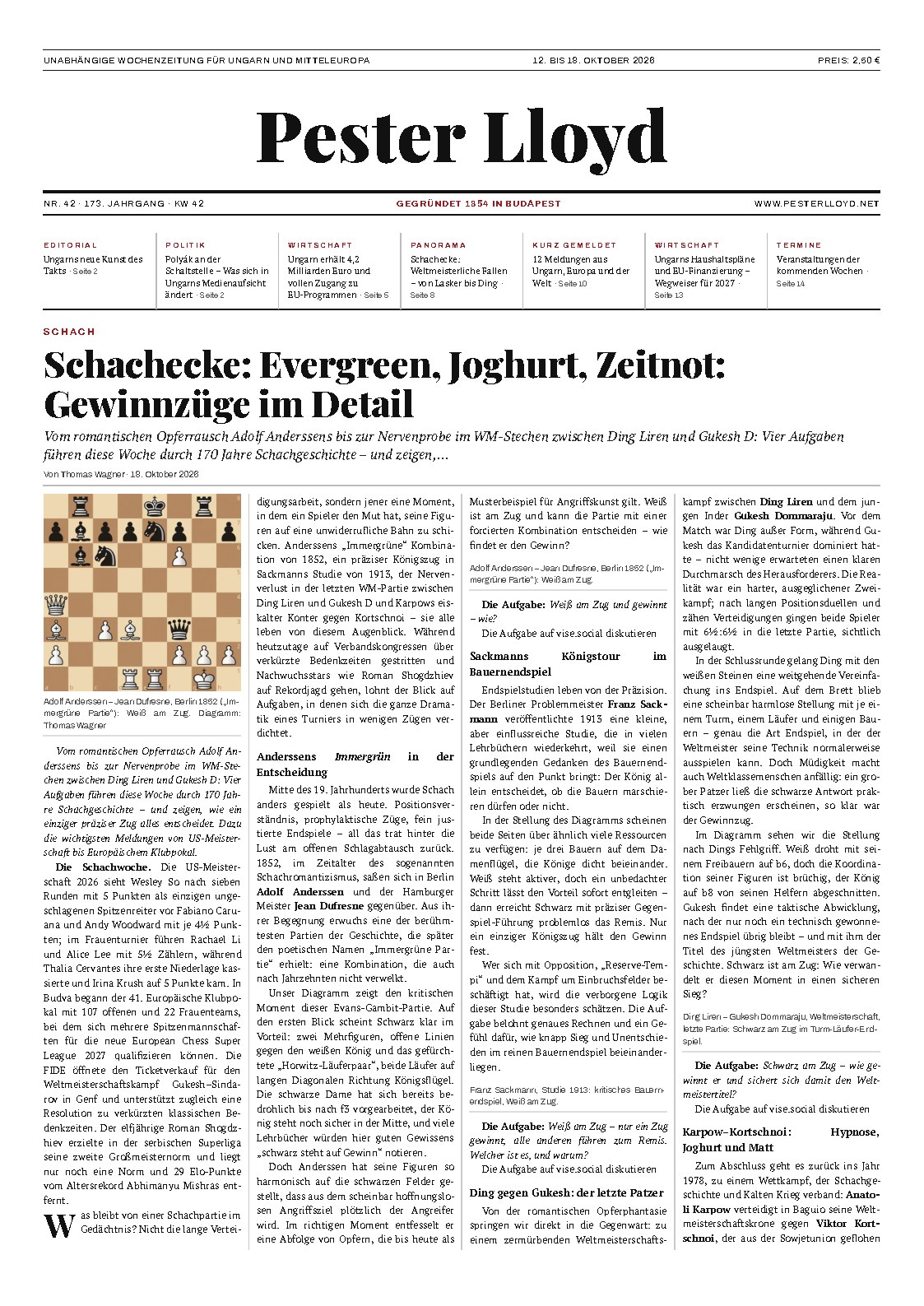
Neu · Jeden Freitag als PDF
Der Pester Lloyd als Wochenzeitung – wie früher am Kiosk, nur digital
Ausgabe 12.–18. Oktober 2026, 17 Seiten im großen Zeitungsformat. Darin unter anderem:
• Schachecke: Evergreen, Joghurt, Zeitnot: Gewinnzüge im Detail• Polyák an der Schaltstelle – Was sich in Ungarns Medienaufsicht ändert
Zeitung ansehen – 2,50 €In eigener Sache – Ihr Kauf unterstützt unabhängigen Journalismus ohne Paywall.