Foreign policy shift – Magyar aims to restore Hungary’s severely strained relationship with Ukraine, tying this to minority protection
Budapest/Kyiv. Péter Magyar, Hungary’s incoming prime minister and leader of the Tisza Party, has proposed a meeting with Ukrainian President Volodymyr Zelensky for early June. The proposed venue is Beregszász (Ukrainian: Берегове – Berehove), the cultural center of the Hungarian minority in Ukraine’s western Zakarpattia region.
The initiative was made public following a meeting with Berehove’s mayor, Zoltán Babják. Magyar received him in Budapest, where Babják reported on the current situation of the Hungarian community as well as the effects of the war. Kyiv has not yet issued a response.
Minority rights as a condition
Magyar links the proposed meeting to clearly defined expectations toward the Ukrainian government. In a statement, he declared:
“It is time for Ukraine to end the legal restrictions that have been in place for more than a decade and to restore all cultural, linguistic, administrative, and higher education rights of Hungarians in Zakarpattia.”
At the center of the discourse are Ukraine’s language and education laws, which, from the Hungarian perspective, restrict the rights of national minorities. Magyar described the concessions announced by Kyiv in 2025 in the field of education as “forward-looking, but not sufficient.” He pointed out that higher education continues to be conducted exclusively in Ukrainian and that final exams can only be taken in the state language.
He also criticized administrative restrictions: “The Hungarian minority cannot demand that official matters be handled in their mother tongue,” even in municipalities with a Hungarian majority. Public officials, he added, remain limited in their use of their native language. Magyar urged Kyiv to “take a major step toward European values as well as genuine freedom and equality.”
Oil for money: the Druzhba deal as the foundation of Magyar’s diplomacy
The initiative launched by Péter Magyar for a meeting with Volodymyr Zelensky takes place against the backdrop of an energy conflict that has structurally strained bilateral relations in recent years. At its core lies the Druzhba pipeline, whose repeated disruptions and politicized use have undermined trust between the two states. Following drone attacks on Russian infrastructure and the resulting interruption of oil flows to Hungary, the Orbán government interpreted these developments as an indirect attack on its own energy security. Kyiv, by contrast, pointed to the wartime context and framed Russia as the primary source of responsibility.
This cycle of mutual accusations was only broken on April 23, when Budapest lifted its veto on the €90 billion EU loan package for Ukraine after oil flows through the Druzhba pipeline resumed. This “oil-for-money” deal marks the end of months of escalation politics during Hungary’s election campaign under the outgoing Fidesz government. Against this background, Magyar’s push for a meeting in Berehove is not merely symbolic: it is an attempt to clear the debris of the Orbán era and initiate a new diplomatic approach in which energy is no longer used as a weapon.
Sources: Péter Magyar Facebook page
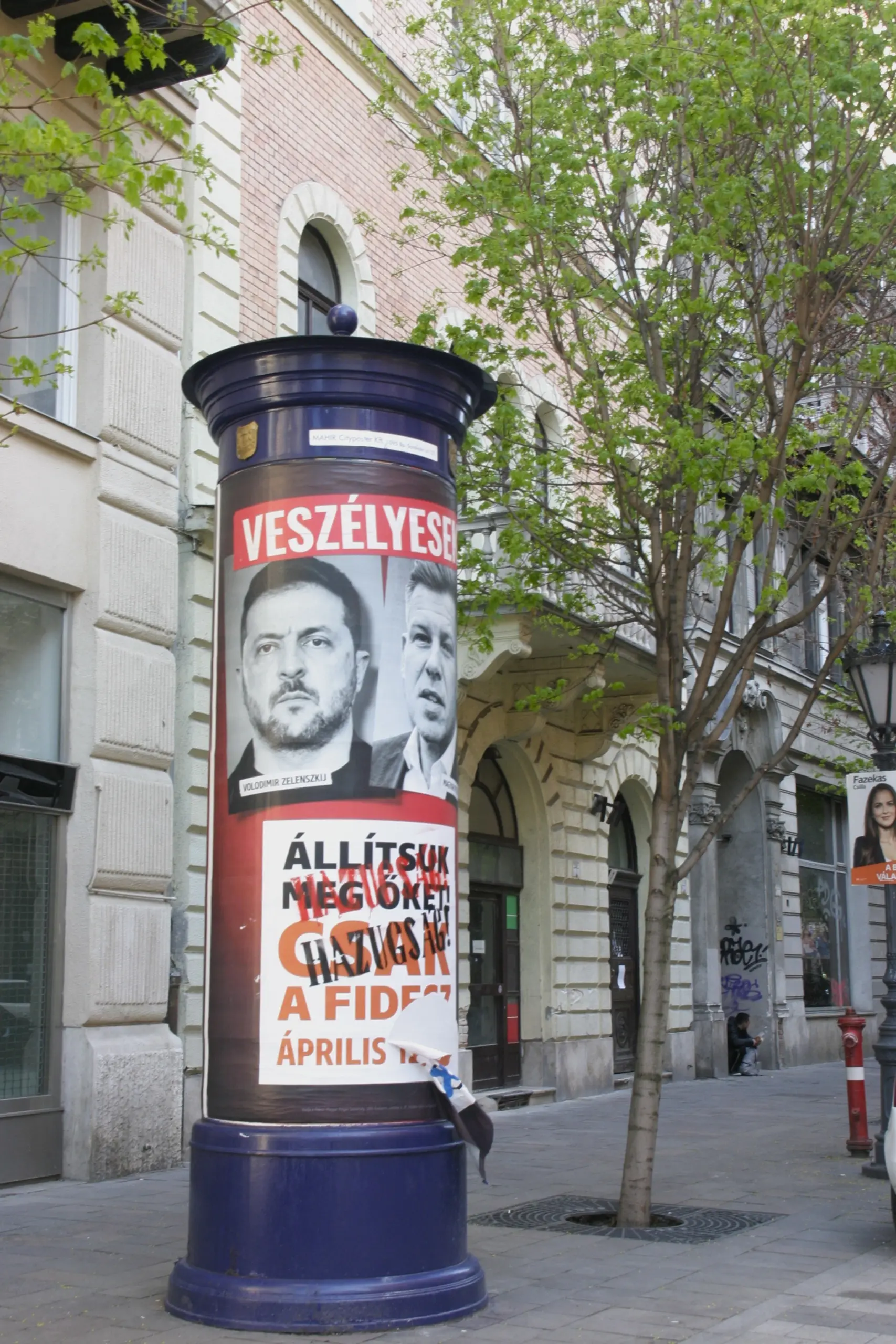
Photo: Fidesz campaign poster for the parliamentary election on April 12, 2026, depicting Zelensky and Magyar with a call to stop them. Anna Breitling / Pester Lloyd / Please credit the author and link the source when used
Unser monatlicher Nachrichtenspiegel: die wichtigsten Meldungen aus Ungarn und Mitteleuropa, einmal im Monat per E-Mail. Kostenlos, kein Spam, jederzeit abbestellbar.
Nachrichtenspiegel kostenlos abonnieren
Neu · Jeden Freitag als PDF
Der Pester Lloyd als Wochenzeitung – wie früher am Kiosk, nur digital
Ausgabe 12.–18. Oktober 2026, 17 Seiten im großen Zeitungsformat. Darin unter anderem:
• Schachecke: Evergreen, Joghurt, Zeitnot: Gewinnzüge im Detail• Polyák an der Schaltstelle – Was sich in Ungarns Medienaufsicht ändert
Zeitung ansehen – 2,50 €In eigener Sache – Ihr Kauf unterstützt unabhängigen Journalismus ohne Paywall.