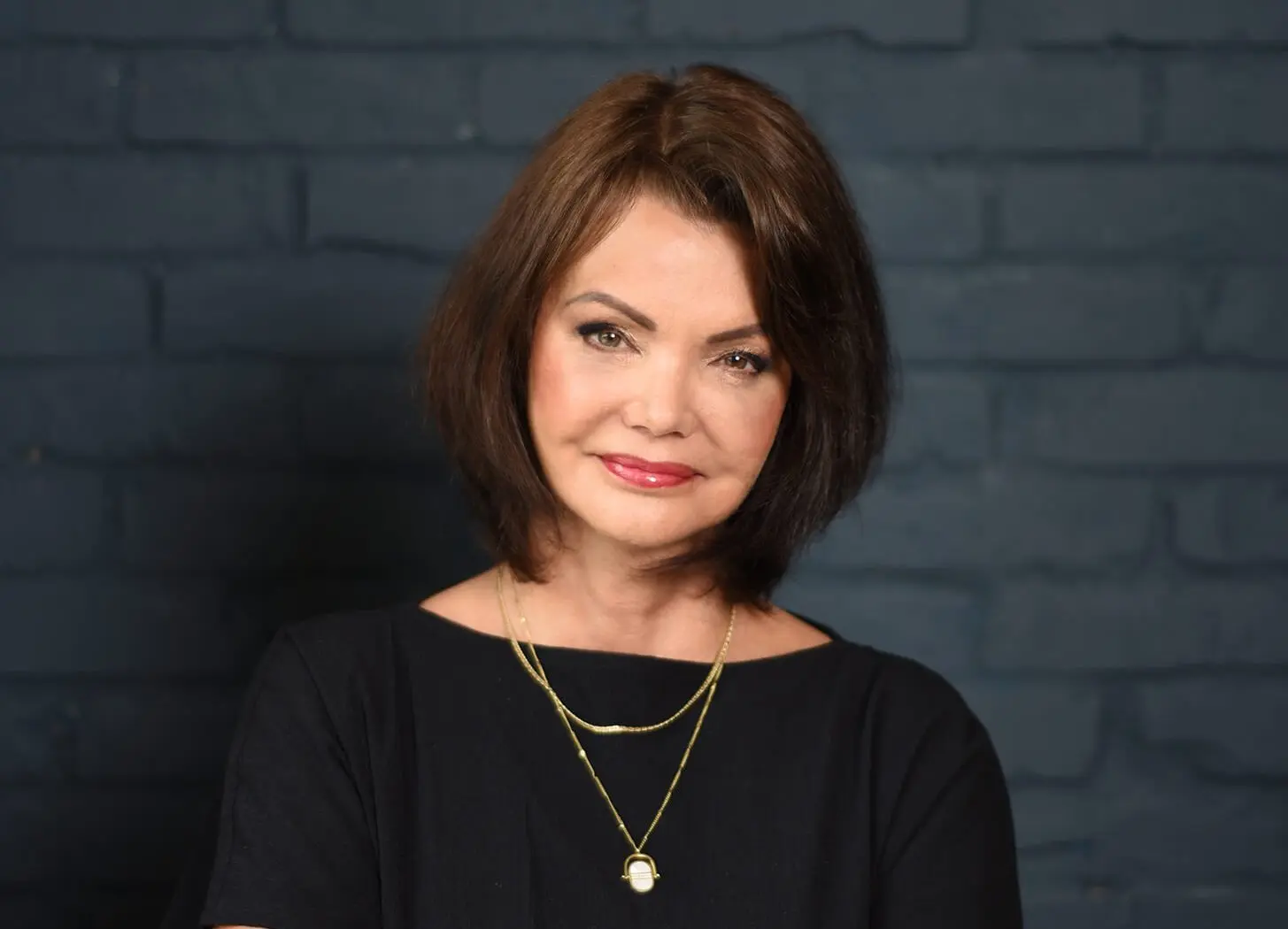
The oeuvre of Hungarian writer, poet, and translator Krisztina Tóth, born in Budapest in 1967, includes poetry collections, novels, short stories, children’s literature, and stage works. Among her more recent publications is the 2022 novel A majom szeme (“The Eye of the Monkey* ”), which has received multiple awards. With My Secret Life, she also published her first English-language poetry collection. A new collection of short stories Kánkán auf dem Glasboden is, according to publisher information, scheduled for release in June this year.
After a period she herself describes as traumatic, Tóth plans to spend more time in Hungary again. In the meantime, she is once more being invited to events in places that previously ignored her including schools. For over a decade, she says, she had been banned from the Hungarian media—like many other intellectuals. She describes the Hungarian cultural landscape as deeply divided; hate speech has long become part of everyday life. Personal attacks and public defamation, she says, were part of Orbán’s propaganda:
“I was called a traitor countless times – by people who themselves contributed nothing to Hungarian culture. I assume that this poisoning will not remain without consequences. It will take a long time for these wounds to heal.”
*English version published by Sevenstories New York (Oct 25) ; also available in Croation and Italian, with translations to French, Spanish, Greek and Tamil due in 2027.
“A month later, a witch hunt was underway”
Tóth reports targeted defamation campaigns and how she was publicly discredited by government-aligned media. After she suggested in an interview to replace a work by Mór Jókai in the school canon with a work of contemporary literature, she became the target of media campaigns that intruded deeply into her private life due to their aggressiveness. Even before the interview, one of her self-authored textbooks had already been banned by the Orbán government; only a centrally controlled standardized edition of textbooks was permitted. In the media, she was defamed as a “mediocre nobody” who “who wanted to eradicate the great national classic from schools.” Deliberately unflattering photos of Tóth were published, and she was publicly analyzed as “untalented” and “stupid.”
She also experienced defamation in her private life, including threatening emails. A teacher at her daughter’s school shared the defamatory newspaper article via the email distribution list with other parents; some stopped greeting her. The media began referring to Tóth as a “traitor,” television viewers voted on her alleged incompetence, and her appearance was mocked. In her everyday life, she was exposed to verbal attacks from strangers; she describes an incident in which she was spat at on the metro. On social media, insulting and racist comments about her children also appeared. At times, she no longer dared to leave the house.
Defamation as a Political Instrument
Her identity as a divorced woman and adoptive mother of a Roma child made her an “ideal target” for misogynistic and racist narratives. The attacks on her as a woman also functioned as a form of mass mobilisation:
“Those who enjoyed seeing a woman suffer in the digital space willingly joined in. Even strangers wrote insulting, sexually explicit messages and threatened me and my children.”
She assesses these attacks as deliberate intimidation meant to demonstrate what criticism under Viktor Orbán’s system entails. She describes the experience as an existential rupture, the consequences of which continue to this day:
“I remember everything and I forget nothing. I will never forgive the Orbán regime’s propaganda machine for what they did.”
She adds that the otherwise independent magazine HVG also contributed significantly to the events through an anonymous article, without having apologised to this day.
“I am a Hungarian writer, and my readers are in Hungary. I will now spend more time in Budapest. But the wounds will not heal, and I cannot forgive. They have hurt and humiliated me. I have done nothing other than bring a good reputation to this country. For me, what happened was an existential rupture.”
Cultural Policy under and After Orbán
When asked whether she plans to return to Hungary in the future and how she assesses the potential of a new government, Tóth responds with hopes and expectations for the period after a possible change of government.
She describes a clear imbalance between the art academies: one of them received substantial financial support under Orbán, with its members receiving high monthly stipends. The second, independent academy, by contrast, receives no state funding and does not have anything close to comparable resources—although it includes two Nobel Prize winners among its members, Péter Nádas and Péter Esterházy. She sees the future of these academies after the end of Orbán’s rule as uncertain. Due to his influence, the original structures are unlikely to be restorable; moreover, the immediate priority will be the recovery of the depleted economy as well as the rebuilding of industry and agriculture.
The education system is also in a poor state, including a shortage of teachers, whose resolution will take a considerable amount of time. On a positive note, Tóth emphasises that she considers the new Minister of Education in a Péter Magyar government to be competent and open, and that women generally hold important positions: “The immediate deputy of Péter Magyar is also a woman, which sends a strong message in this macho society.”
Misogynistic narratives in political Discourse
Tóth expects that the political climate will change only very slowly. Public discourse, she says, continues to be shaped by problematic practices and narratives. As an example, she refers to the circulation of an image by the popular anti-Orbán influencer Róbert Puzsér, which he published after the victory of the Tisza Party. It shows an explicitly sexual act in which Fidesz, represented as a woman in bed, is humiliated by the Tisza Party, which is depicted as the man.
She situates this example within the political climate she criticises:
“I find this terrifying and disgusting! The subordinate position is weak and, according to a Hungarian, misogynistic way of thinking, a woman. This attitude must absolutely disappear, because otherwise we will never belong to Europe in our thinking. The influencer publicly said it was just an opinion and that the image is very funny – whoever does not like it simply does not understand humour … This must change, otherwise we will fall back exactly to where we are trying to work our way out of!”
She assesses the extent of Orbán’s long-term propaganda as a deep division within the country, as it has “caused significant psychological damage,” the repair of which will take at least a decade
Language, Visibility, and Literary Responsibility
When asked what challenges women writers are particularly confronted with today, Tóth identifies language as the main one: Hungarian women writers depend on translations in order to achieve international relevance. She also sees engagement with broader political phenomena as a priority, rather than focusing exclusively on individual experiences.
She hopes that in contemporary Hungarian literature, gender will increasingly recede into the background and that women writers will be perceived not as “women in literature” but as part of literature as a whole. However, she says, there is still a long way to go before this becomes the norm in Hungary.
“I do not want people to kiss my hand, really not, I want to be treated as an equal human being, and I do not want to be asked anymore who is taking care of my child while I am at a Hungarian book presentation!”
A central position she holds is that experiences should be told in a universally relatable way; authenticity, she argues, contributes significantly to understanding.
“For example, I have been hurt, but I do not want that to be my topic. At the same time, I cannot ignore it. I will continue my work as before. I believe that a writer must keep a distance from current power, in fact from any power. Literature must be independent and maintain critical distance from current events. In my opinion, good literature asks questions, it does not give answers. It tries to ask the most important questions: Where is the world heading? How can we preserve our personal integrity? What role does literature play in this – how can it help?”
Only in this way, she argues, can the polarisation of thought promoted by Orbán, as well as the coarsening and vulgarisation of language, be countered:
“It is a populist method to simplify reality and claim that one has understood it, but the task of thinkers is to grasp the world in all its diversity and subtlety.”
Which contemporary Hungarian women writers should international readers know?
“I would definitely recommend the works of Petra Szőcs. Mónika Mesterházi is an excellent poet and translator of English literature, as is Anna Szabó T. Réka Mán-Várhegyi and Edina Szvoren are also outstanding prose writers.”
“In general, there has been a clear hostility towards intellectuals.”
Viktor Orbán has repeatedly constructed various groups as enemies, including migrants, the EU, and also educated women. Tóth explains that this persistent construction of enemy figures has created a sense of threat, whereby criticism could be labelled as “betrayal.” As a result, despite 54 published books, she is perceived not through her work but through Orbán’s propaganda.
According to Tóth, Orbán has fostered a general hostility towards intellectuals and artists through political measures and the public devaluation of their work. Internationally known philosophers such as the late Ágnes Heller were taken to court; during the global pandemic, part of the polemical treatment of critical voices included telling artists they should “get a job.”
Tóth on the Rejection of Critical Art in Orbán’s Hungary:
“Authoritarian societies do not like real art, only kitsch – especially historical kitsch that produces a false nostalgia for the past. Populist leaders insist that art must be accessible to the general public. In reality, however, they promote nonsense and kitsch, because real art is a danger – it raises questions.”
She stresses that not only publicly defamed individuals suffered under Orbán; the dignity of those drawn into the system – including children – was also severely violated.
The role of literature when democratic norms are under pressure
“We must restore the integrity of thinking and rebuild a culture of debate. We must make the importance of argumentation and reason clear. Viktor Orbán relied on short, simplified messages that appeal to emotions. However, politics based on hatred is not sustainable in the long term. Literature must restore trust in language, because only through words and stories can we understand one another and the complex world around us.”
Sources: Krisztina Tóth, tothkrisztina.com
Pictures: tothkrisztina.com, Copyright by Krisztina Tóth
Unser monatlicher Nachrichtenspiegel: die wichtigsten Meldungen aus Ungarn und Mitteleuropa, einmal im Monat per E-Mail. Kostenlos, kein Spam, jederzeit abbestellbar.
Nachrichtenspiegel kostenlos abonnieren
Neu · Jeden Freitag als PDF
Der Pester Lloyd als Wochenzeitung – wie früher am Kiosk, nur digital
Ausgabe 14.–20. September 2026, 10 Seiten im großen Zeitungsformat. Darin unter anderem:
• Ungarn ordnet sein Verhältnis zu Deutschland neu – Aussenministertreffen
Zeitung ansehen – 2,50 €In eigener Sache – Ihr Kauf unterstützt unabhängigen Journalismus ohne Paywall.