Why Washington is using Hungary as an ideological and institutional lever against the EU
Budapest/Munich. Anyone who understood Marco Rubio’s appearance at the Munich Security Conference as a politely packaged repair attempt of transatlantic relations focused on tone rather than substance. The substance was culture war. Two days later, it found a practical stage in Budapest. Viktor Orbán, under pressure in Hungary’s election campaign, was publicly elevated by the US Secretary of State, as if American interest in Hungary’s future depended on a single individual.
In a commentary for Deutschlandfunk’s MediaRes, columnist Marina Weisband described a central reflex in parts of the media: the avoidance of clear terminology, the reluctance to call the obvious by its name. In Rubio’s case, this hesitation is not only semantically uncomfortable but politically consequential. Many outlets spoke of “relief” that Rubio’s speech signaled willingness for partnership and a return to shared “Western” values. Yet the question is which partnership and which values.
Rubio’s Munich speech relies on building blocks familiar in Europe since the 1920s: civilization framed as a blood and soil narrative, internal enemies depicted as erosion, the nation cast as a threatened community of fate, international rules described as shackles, decadence invoked as diagnosis. His subsequent visit to Orbán illustrates the function of this language: to elevate an EU disruptor capable of paralyzing Brussels.
“Under President Trump, the United States of America will once again take on the task of renewal and restoration, driven by a vision of a future as proud, as sovereign, and as vital as our civilization’s past. And while we are prepared, if necessary, to do this alone, it is our preference and it is our hope to do this together with you, our friends here in Europe.”
The vision of Western predominance associated with Donald Trump stands in tension with what are commonly understood as Europe’s core values: democracy, peace, civil society participation, social balance, and millennia old cultural traditions.
Munich: The West as a community of fate, not a legal order
In Munich, Rubio does not portray NATO as a pragmatic alliance. He presents “Western civilization” as a quasi natural unity, bound together by references to “Christian faith,” “heritage and culture,” and the ethnically charged notion of “ancestry.” In this narrative, Europe’s pluralism appears not as strength but as weakness. Migration is stylized as an existential threat, although Europe has long been shaped by displacement and exchange across peoples and cultures, forming the mosaic that defines the continent. Climate policy is sidelined and dismissed as sectarianism. International institutions are framed as self disempowerment. Why adhere to the UN, EU, WTO, WHO, or other bodies if the nation already knows better?
The fascist quality lies not in a single insult but in the dramaturgy. First, a culturally homogeneous community is asserted. Second, its boundaries are declared a matter of survival. Third, a moral state of emergency follows, in which counterarguments appear naive or treacherous. This structure explains the resonance with European far right agendas that have long warned of “civilizational erasure” and the “demise of Christian culture.” The Guardian explicitly identified this connection, describing Rubio’s offer as friendship “on white, Christian, MAGA terms.”
The rhetoric serves a function. It shifts the axis of conflict away from concrete policy disputes toward fundamental identity questions. Those who speak in this register do not build coalitions. They sort people. That is the core.
Budapest: A campaign speech at state expense
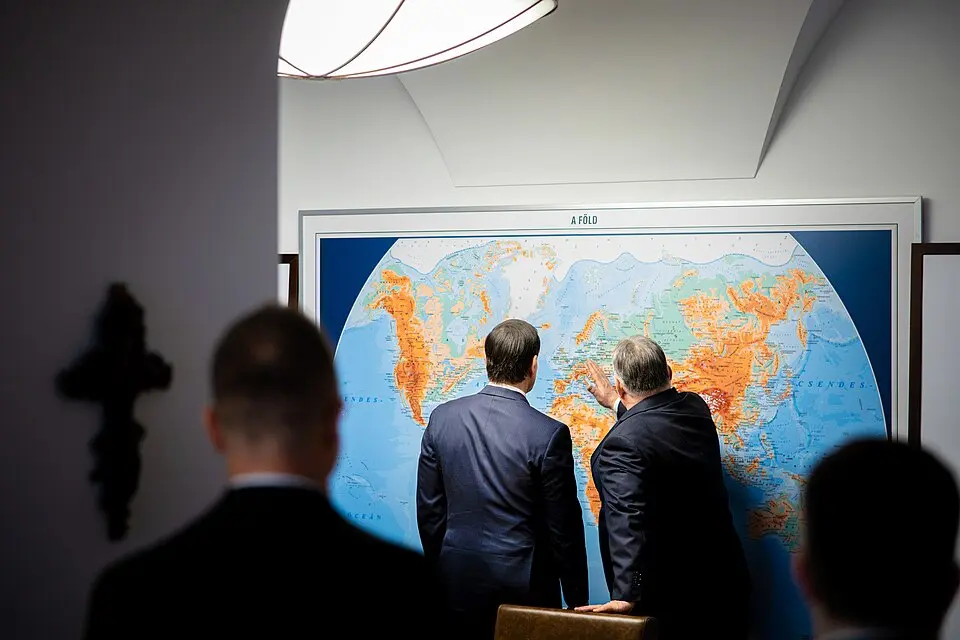
On 16 February 2026, Rubio stood next to Orbán in Budapest and made statements that in established democracies would be viewed as overreach. Trump, he said, is “strongly” committed to Orbán’s success. “Your success is also our success.” It is in the “national interest” of the United States that Hungary succeed, “especially as long as you are Prime Minister and leader of this country.”
This is not routine diplomacy. It is political intervention. It targets a country where Orbán, according to recent polls, trails Péter Magyar’s TISZA party by eight to ten percentage points, appearing vulnerable in a space where Fidesz has sought invulnerability since 2010.
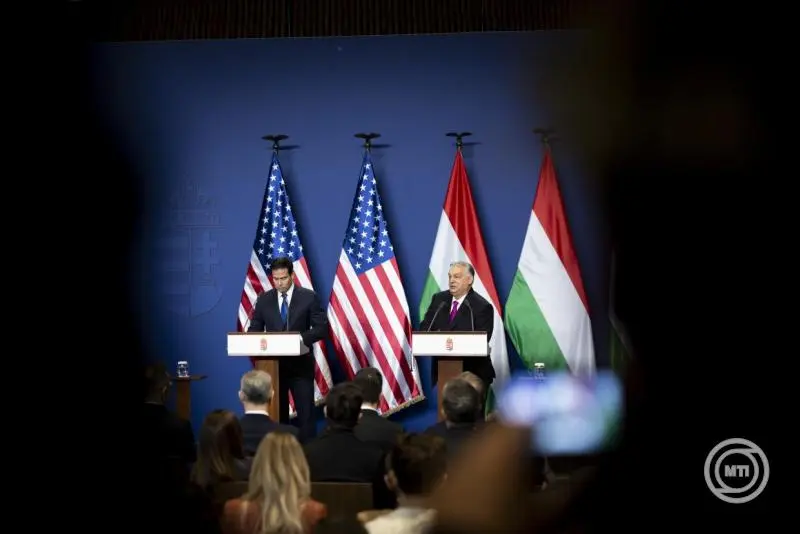
The subtext is clear: Washington does not want Hungary, it wants Orbán. Orbán receives what he most urgently needs domestically, the image of international backing that counters the narrative of an isolated government. The message suggested is not that Orbán stands alone, but that Brussels does.
What Trump wants from Hungary
Hungary is a small country. Yet within the EU it holds leverage disproportionate to its economic weight: the capacity to block. In a system that requires unanimity on key issues, obstruction becomes strategic capital. Orbán has refined this role, acting as a brake on EU policy toward Ukraine, as a persistent challenger on rule of law matters, and as a political importer of Kremlin narratives.
For Trump, this is useful because it weakens the EU as a geopolitical actor without Washington having to confront Europe directly. Supporting forces that challenge European cohesion from within achieves the same effect. This concern has been voiced openly in Brussels and echoed in international analysis. The Guardian wrote that Rubio’s position reinforces fears that the United States seeks to promote “disunity.”
There is also ideological value. Orbán provides a European test version of the MAGA culture war, complete with anti woke measures, anti migration rhetoric, and Brussels cast as adversary. Rubio supplies the American register, replacing party slogans with the language of Western civilization.
What Hungary wants from Trump
Orbán needs two things: legitimacy and time.
Legitimacy, because his system has for years been described not only as illiberal but as institutionally distorted. Independent MP Ákos Hadházy has referred to it as a hybrid regime comparable to Turkey: elections exist, yet structural dominance over resources, public discourse, and media remains entrenched, backed by a state apparatus aligned with the governing party. For such a system, recognition from Washington functions as domestic currency. It compensates for what Brussels no longer provides. The narrative of a hostile EU has lost some of its force.
Time, because the election campaign is unusually confrontational. Orbán portrays the opposition as a foreign construct, speaks of forces in Brussels directing events, announces action against “pseudo civil organizations” and “bought journalists,” and refers to a “machinery of repression” to be dismantled after the April election. Rubio’s appearance in Budapest aligns with this dynamic. Publicly courting Orbán as “leader of this country” normalizes the personalization of power that characterizes Hungary’s internal political order.
The deal behind the posture
The underlying arrangement is straightforward and cynical.
Hungary presents itself as both ideological frontier and institutional lever: an EU member state able to block EU decisions while waging an official culture war against woke and globalist forces. The United States gains influence over EU dynamics without being an EU actor.
Orbán secures the narrative he needs for his campaign: that his policies are not the idiosyncrasies of an isolated provincial leader but part of a new Western axis. Rubio provides the endorsement, Munich the stage, Budapest the images.
Those who hesitate to call this fascist are free to choose another term. What alternative more precisely captures the combination of civilizational myth, internal enemy designation, anti pluralism, and person centered aesthetics of power is unclear to the Pester Lloyd. As Marina Weisband argued, the problem is not the harshness of the word but the comfort in avoiding it.
Sources: MTI.hu, ORF.at, The Guardian, Deutschlandfunk @mediasres, Deutschlandfunk audio commentary by Marina Weisband, US Department of State
Photo: Secretary of State Marco Rubio with Viktor Orbán, US Department of State.