Media coverage of Peter Magyar’s assumption of office – personal attacks and warnings about cultural policy dominate the reactions of pro-Orbán media to the change in government.
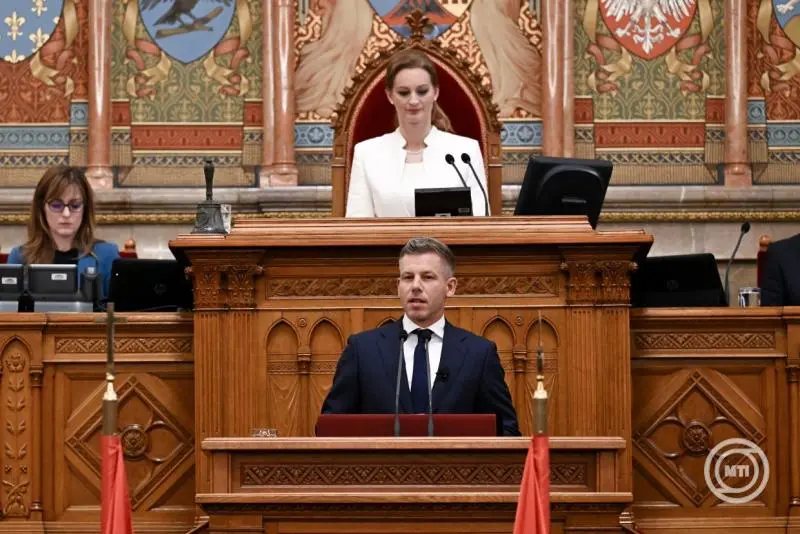
Budapest. In front of the Hungarian Parliament, on 09/05/2026—symbolically placed on Europe Day—there was a festive and exuberant atmosphere for the swearing-in of the new Prime Minister, Péter Magyar. According to Tagesschau, tens of thousands of people gathered to celebrate the inauguration of the pro-European politician and his Tisza Party. The right-conservative politician thus replaced Viktor Orbán’s 16-year government on 12 April 2026. In a symbolic gesture, the European flag was raised again at the Parliament—an emblem that had at times disappeared from public space under Orbán. Images and videos of the celebrations spread rapidly on social media. Particular attention was given, for example, to a recording of the future Minister of Health,Zsolt Hegedűs, in which he can be seen dancing exuberantly in front of the Parliament. Shortly after the Tisza Party’s election victory, another video of the future minister had already circulated, capturing the euphoric mood among Magyar’s supporters.
Aggressive rhetoric and political announcements
Péter Magyar, who until 2024 had himself been a member of Orbán’s Fidesz party, deliberately left out certain sociopolitical issues during his election campaign, according to The Guardian. Questions regarding LGBTQIA+ rights or climate policy played no role in his campaign. In migration policy, Magyar has so far positioned himself significantly more restrictively than in the areas of anti-corruption and media freedom, where he clearly distinguished himself from Orbán’s policies. Overall, however, the differences to the previous government in this field are comparatively smaller. According to the European Council on Foreign Relations, the centre-right Tisza Party made it clear during the campaign that it largely holds migration-sceptical positions in this policy area, which are close to those of the Fidesz government.
At the same time, Magyar’s tone toward the Hungarian media was already marked by a confrontational stance during the campaign. In interviews with state radio, he announced that after taking office he would temporarily suspend news programs on public broadcasters and introduce a new media law as well as a reform of the media supervisory authority. In doing so, he used the medium of radio itself to confront state media within the context of reporting. He compared the spread of fear and lies to North Korean and National Socialist propaganda in Germany. He accused state media of systematically disadvantaging him compared to Viktor Orbán—a claim which those media outlets in turn rejected.
With the announcement that he would pass a new press law and establish a media authority under his government, he stated that state media could “finally do what they are actually there for.” After the interviews, Magyar continued to express himself in an offensive manner on social media: “We are currently witnessing the final days of a propaganda machine. After the formation of the Tisza government, we will suspend the news broadcasts of the ‘public’ media until their public-service character is restored.”
Calls for reform of Hungary’s media landscape loyal to Orbán
International organizations such as Reporters Without Borders and Human Rights Watch have explicitly warned about the manipulation and subversion of Hungarian media under the Orbán government. Through legislative measures, economic pressure, and targeted repression, the independence of the media has been gradually undermined. A central role in this process is played by the KESMA foundation, established in 2018, which, according to Pester Lloyd (2025), controls around 80% of the Hungarian media landscape.
Against this backdrop, hopes among press freedom advocates are increasingly directed toward Péter Magyar and his new Tisza government. The partners of the Media Freedom Rapid Response (MFRR) emphasize in a statement by the European Centre for Press and Media Freedom that comprehensive media reform must be among the new government’s most urgent tasks. A profound structural overhaul is seen as crucial for the “re-democratization” of the country. Demanded measures include in particular strengthening media pluralism, reforming media oversight, abolishing politically directed allocation of advertising, and repealing repressive regulations such as the Sovereignty Protection Act. Whether the new government will indeed prioritize the strengthening of independent media is likely to serve as an important indicator of its commitment to rule-of-law reforms.
Tone of Orbán-aligned media: criticism beyond politics
Reading reports on Magyar’s inauguration in Orbán-loyal media, it becomes apparent that substantive aspects of the new government are rarely addressed. Instead, the focus is often on symbolism and personal attacks. Under the headline “The Tisza celebrants left trash on Kossuth Square instead of civic values,” the newspaper Origo writes: “There is no need for many comments; it is enough that Tisza fans still have a lot to learn about decency and behaviour.” The article illustrates this with visual material and commentary on the alleged lack of manners among the celebrants. The online portal Origo, one of Hungary’s most popular news sites, was reportedly politically independent until 2014, and, according to eurotopics, has belonged to the government-aligned media foundation KESMA since 2018. In another article titled “This is how the world sees the future Minister of Health,” Origo again highlights the dancing performances in front of Parliament by Zsolt Hegedűs that were widely shared on social media. Various comments are cited, including the conclusion of one user: “Zsolt Hegedűs, the Minister of Health in the government of Péter Magyar, will show why people will regret the loss of Orbán.” Overall, comments and quotations dominate, portraying the future health minister as embarrassing and unprofessional. In contrast, Magyar’s political statements and announcements regarding his inauguration are not addressed.
The Orbán-aligned platform Ungarn Heute, one of the leading German-language news platforms in the country, stated under the headline “Homage to a departing great fighter” that the consequences of the turning point marked by the Tisza Party’s victory on 12 April would bring “driving forces and logics” that “Hungarian society has not yet understood and could not yet understand.” Viktor Orbán was described as a defender of national interests against a “liberal hegemony” and the “wave of globalisation.” Magyar’s victory was portrayed as a rupture with a supposed national consensus, while Péter Magyar was primarily reduced in personal descriptions to his lifestyle and public image.
Despite Magyar’s clear popularity, Ungarn Heute focuses on the appearance and lifestyle of the new prime minister: “Time will tell who has recognised the truth. In any case, after the celebrations on Kossuth Square are over, the 45-year-old man, who campaigned in white trainers and slim-fit jeans, led a lifestyle characterised by disco parties and alcoholic excesses, and allegedly wiretapped his wife for political reasons, will have to take his seat in the parliamentary building and adjust his behaviour to the rank of one of the highest office holders.” In this portrayal, Magyar embodies—unlike Orbán, depicted as a serious statesman—the image of a pleasure-seeking individual who represents a “Dionysian philosophy of life of a bon vivant.” The narrative conveyed by Ungarn Heute draws on central elements of rhetoric recently used by Orbán during the election campaign. Thus, rejection of the European Union is linked to the warning that “our compatriots” have voted for an unconditional alignment with a “declining West.”
Furthermore, the article uses populist terminology in relation to the EU. Magyar must decide on issues such as the “gender lobby” and “migration” whether he will place Hungary “on the edge of the abyss alongside other European nations.” The piece concludes with the words: “Honour to the departing great fighter. Hungary above all, God above us all!” Against the backdrop of the previously used nationalist terminology, this ending appears unsurprising.
Péter Magyar’s inauguration marks a political turning point in Hungary, accompanied by high expectations as well as clear tensions. While his supporters celebrate a departure towards European integration and democratic renewal, Orbán-aligned media respond with sharp criticism, personalisation, and at times polemical exaggeration—a reflection of a deeply polarised media landscape.
Sources: The Guardian, tagesschau, zdfheute auf Instagram, Ungarn heute, European Centre for Press and media Freedom, eurotopics, European Council on Foreign Relations
Photos: Wikicommons / CCBYSA4.0
Unser monatlicher Nachrichtenspiegel: die wichtigsten Meldungen aus Ungarn und Mitteleuropa, einmal im Monat per E-Mail. Kostenlos, kein Spam, jederzeit abbestellbar.
Nachrichtenspiegel kostenlos abonnieren
Neu · Jeden Freitag als PDF
Der Pester Lloyd als Wochenzeitung – wie früher am Kiosk, nur digital
Ausgabe September 2026, 55 Seiten im großen Zeitungsformat. Darin unter anderem:
• Importierte Identitätspolitik – Amerika im irrationalen politischen Sumpf• Showdown im rumänischen Parlament – Neuer Versuch der Regierungsbildung droht zu scheitern
Zeitung ansehen – 2,50 €In eigener Sache – Ihr Kauf unterstützt unabhängigen Journalismus ohne Paywall.
