
Budapest. The Pride Parade on 27 June 2026 is taking place under new political circumstances. For the first time in years, the demonstration for the rights of lesbian, gay, bisexual, transgender, and non-binary people can again be held legally. At the same time, it comes in the context of a change of government after 16 years of homophobic policies under former Prime Minister Viktor Orbán. The Háttér Society, the largest and oldest active LGBTQIA+ organisation in Hungary, commented in advance of the Pride Parade on security issues and the prospects of the LGBTQIA+ community, which has consistently been marked by extensive restrictions, administrative intimidation, and political bans. In a personal exchange, Dóra Sós, Head of Communications at the Háttér Society, provided me with various statements from Eszter Polgári, Head of the Legal Program at the Háttér Society.
According to the organisation, as in previous years, three counter-demonstrations under the slogan “Protest against LGBTQP propaganda” were registered with the police. The “P” reportedly stands for “pedophilia.” However, the police restricted their routes in order to prevent any overlap with the Pride march. The applications were reportedly submitted by private individuals with links to the far-right party Mi Hazánk. According to Eszter Polgári, counter-demonstrations against the Pride march are not unusual, but they remain significantly outnumbered by Pride participants. It is expected that the police will separate the counter-demonstrators from the Pride march, as in previous years, and prevent any physical contact. Overall, the organisation assumes that the event will take place under similar security conditions as in previous years, as the police have consistently secured the Pride march professionally and there are no indications of an increased security risk.
“We believe that the Pride will be as safe as in previous years (even last year when it was a banned event, the police in an exemplary way secured it and kettled the counterdemonstrators). Nothing indicates that the security risks are more serious this year.”
With regard to the previous ban on Pride, the Háttér Society refers to a reform proposal by several civil society organisations. Among others, the Háttér Society and Amnesty International Hungary call on the government to repeal the legal provisions that have so far served as the basis for banning Pride events. At the centre of this is Section 13/A of the Hungarian Assembly Act, which was introduced with reference to the explicitly homophobic “Child Protection Law” and served as the legal basis for police bans on Pride demonstrations. The organisations also call for the repeal of the legal basis allowing the use of automated facial recognition in connection with Pride events. Instead, they argue, a public debate should be held on the conditions under which such technologies are justified. The so-called “Child Protection Law” was declared incompatible with EU law in April 2026 by a ruling of the Court of Justice of the European Union. This incompatibility with EU law provides an additional argument for repealing the relevant amendments to the Assembly Act.
According to Eszter Polgári, the situation for civil society organisations such as the Háttér Society has significantly improved since the change of government. She stated that state-led campaigns against sexual and gender minorities, as well as against civil society organisations, have been discontinued.
„The change of government has significantly improved the situation of Háttér Society and civil society in general. There is no more scapegoating against sexual and gender minorities and those protecting their rights and work for their wellbeing, CSOs critical of the government are not vilified and the Sovereignty Protection Office that was at the forefront of the attacks on CSOs and free press will be abolished next week.”
Sources: hatter.hu, orf.at
Photo: Budapestpride.hu
Unser monatlicher Nachrichtenspiegel: die wichtigsten Meldungen aus Ungarn und Mitteleuropa, einmal im Monat per E-Mail. Kostenlos, kein Spam, jederzeit abbestellbar.
Nachrichtenspiegel kostenlos abonnieren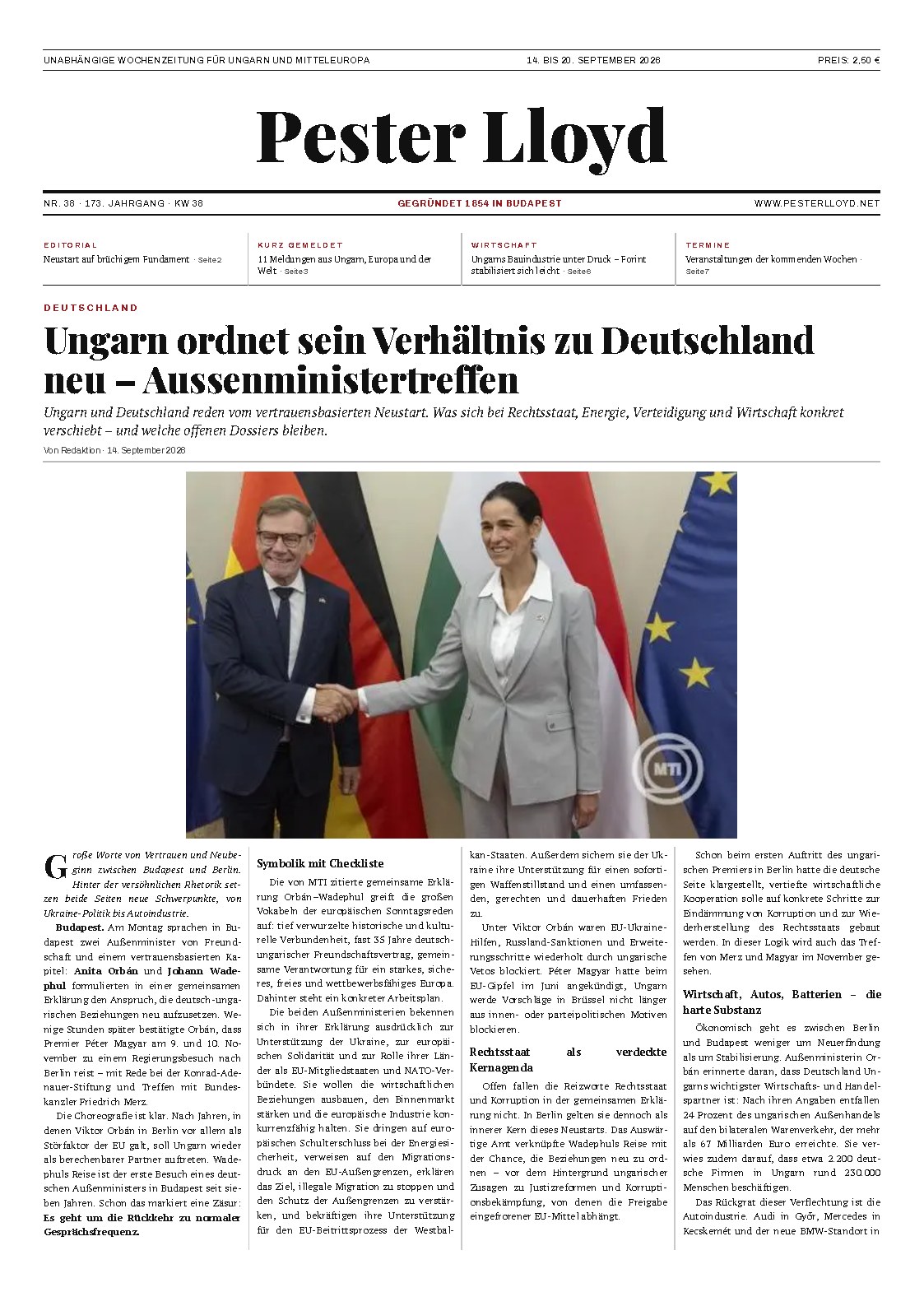
Neu · Jeden Freitag als PDF
Der Pester Lloyd als Wochenzeitung – wie früher am Kiosk, nur digital
Ausgabe 14.–20. September 2026, 10 Seiten im großen Zeitungsformat. Darin unter anderem:
• Ungarn ordnet sein Verhältnis zu Deutschland neu – Aussenministertreffen
Zeitung ansehen – 2,50 €In eigener Sache – Ihr Kauf unterstützt unabhängigen Journalismus ohne Paywall.